The kart

Anatomy of a racing kart

Every part that matters, from 30 mm chassis tubes to the seat, and why the frame is the suspension.

Lesson 06/23 · 9 min · Basics

Lesson

06/23

Duration

9min

Level

Basics

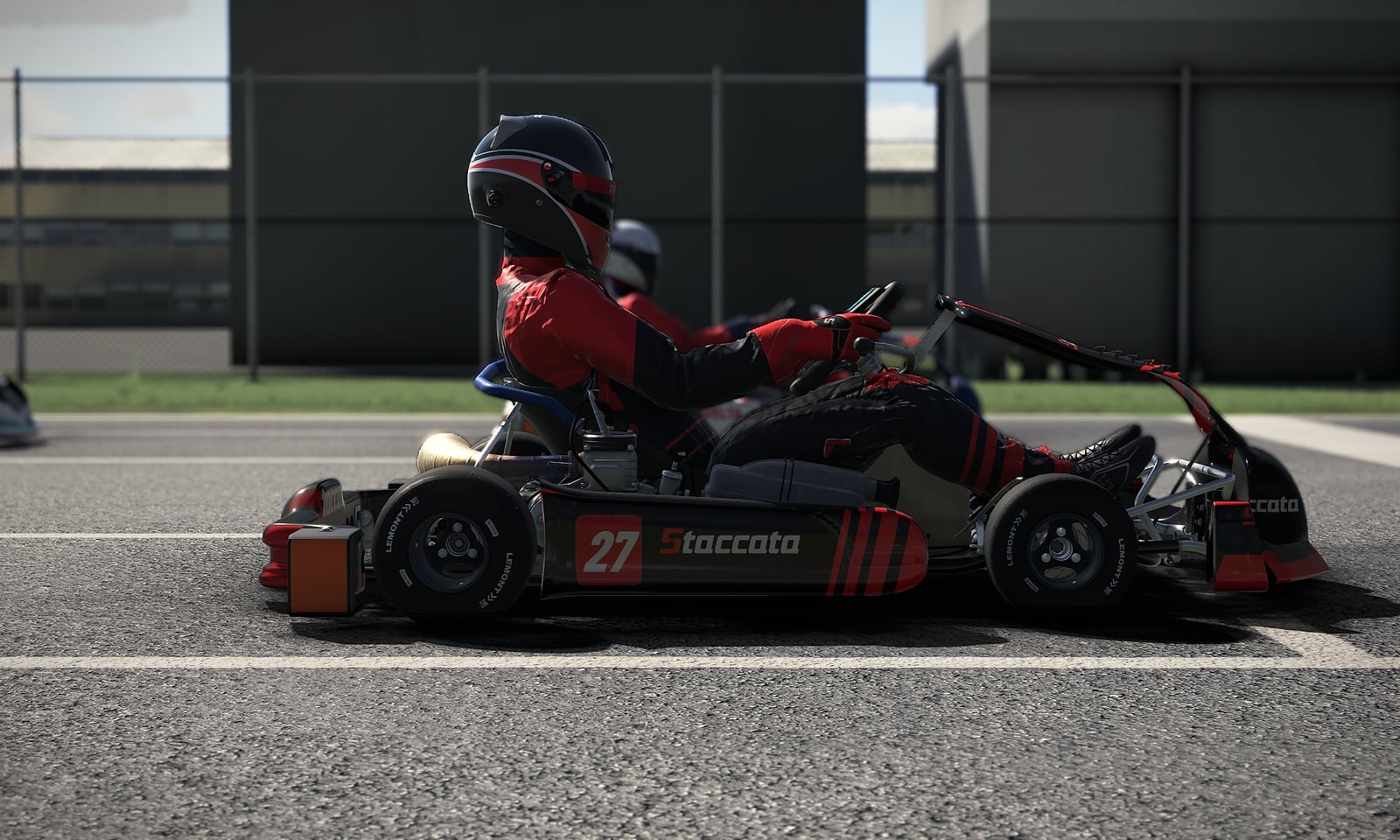
A racing kart is the simplest four-wheeled racing vehicle there is, and that simplicity is exactly why setup matters so much. There is no suspension and no differential. Every load goes through the frame, and the frame itself is the spring. Learn the parts and you can already predict half of what a setup change will do.

1400 mm020407091112010305060810
Top view of a direct-drive kart with the parts you will be asked about at scrutineering.

The frame is welded from chromoly steel tube, typically 28, 30 or 32 mm in diameter, and many chassis mix diameters in different areas. Tube diameter is a stiffness decision, not a strength decision: a 32 mm frame resists twisting more, a 28 mm frame flexes more. Most Senior chassis are built around 30 mm as a compromise. Manufacturers also weld in different tube layouts and bracing, which is why two 30 mm chassis from different brands do not behave alike. Staccata does not simulate tube diameter: in the game you tune stiffness with the axle, hubs, track widths and seat stays, and there the rule is: stiffer means a freer rear.

Key takeaways

  • No suspension and no differential: the steel frame is the spring and both rear wheels are locked together.
  • Tube diameter (28/30/32 mm) is a stiffness choice: thinner flexes more. The game does not simulate it; there you set stiffness with the axle, hubs, track widths and seat stays.
  • The solid rear axle, its hubs and its bearing carriers are among your most powerful tuning items.
  • The seat, its stiffness and its stays are structural tuning parts, not just where you sit.
  • Most direct-drive classes brake on the rear axle only; KZ2 and DD2 have front brakes too.

Check yourself

Question 1/4

What does a kart use instead of suspension?

4 questions · 75% to pass