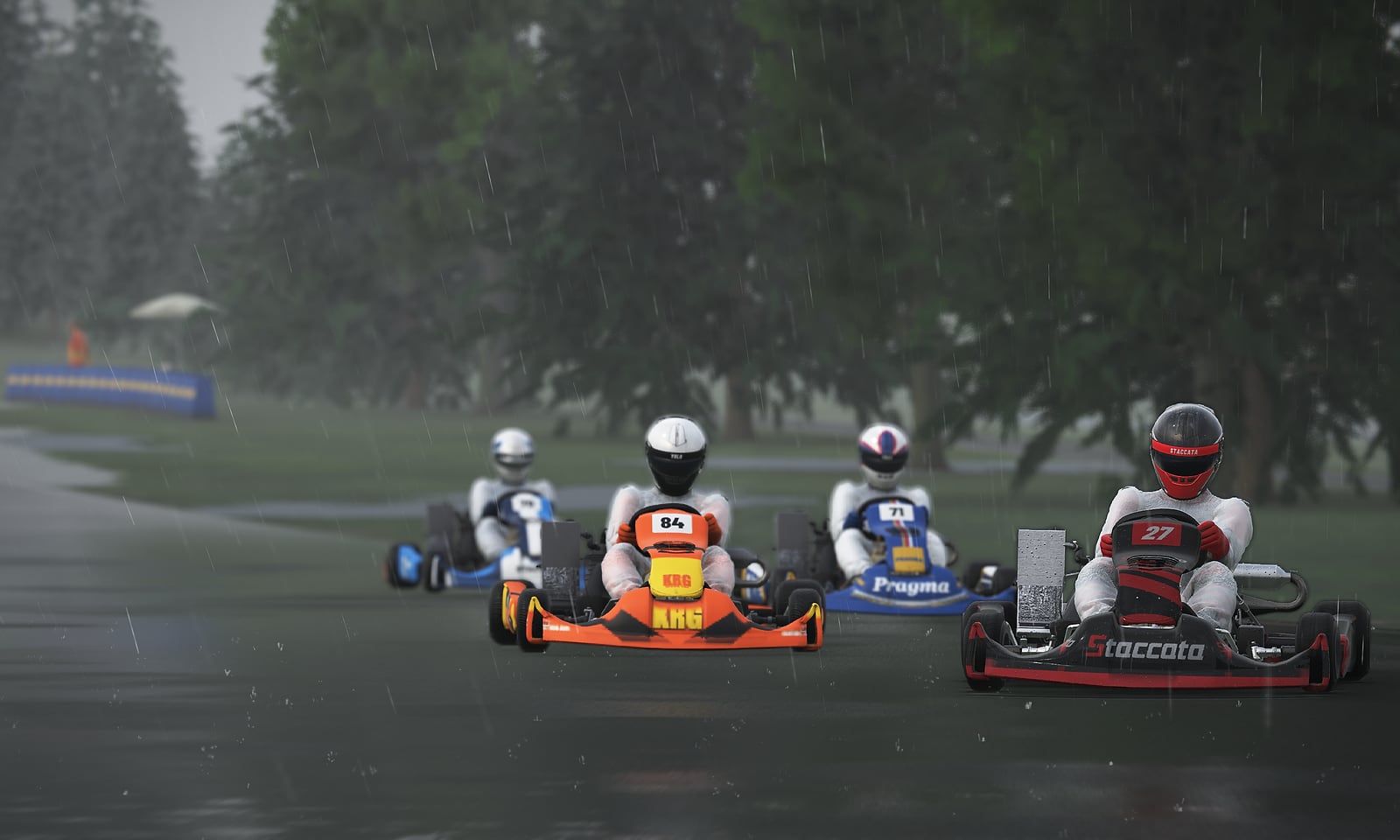
Wet races are where championships change hands. Grip is low, everybody is slow, and the gap between a driver who understands water and one who does not is measured in seconds a lap rather than tenths. The good news is that most of it is learnable.
Drill
Separate the inputs
Goal: Drive 5 valid laps
In the dry, the fastest surface is the dark rubbered line. In the wet, that same rubber plus water behaves like polished ice. So the wet line moves: wider on entry, off the rubber through the middle, often across parts of the track you never use in the dry. The wet line is also straighter: you brake earlier and in a straight line, turn the kart with less steering angle, and get to the throttle carefully once it is pointed.
- Look for the colour change: clean tarmac is often lighter than the rubbered line.
- Kerbs are sometimes grippier than painted or rubbered surfaces when wet, but painted kerbs are not. Learn each one.
- Water drains to the lowest part of the track; avoid the puddles rather than the whole side of the circuit.
- As the track dries, the dry line comes back first, so the fast line migrates back lap by lap. Keep checking.