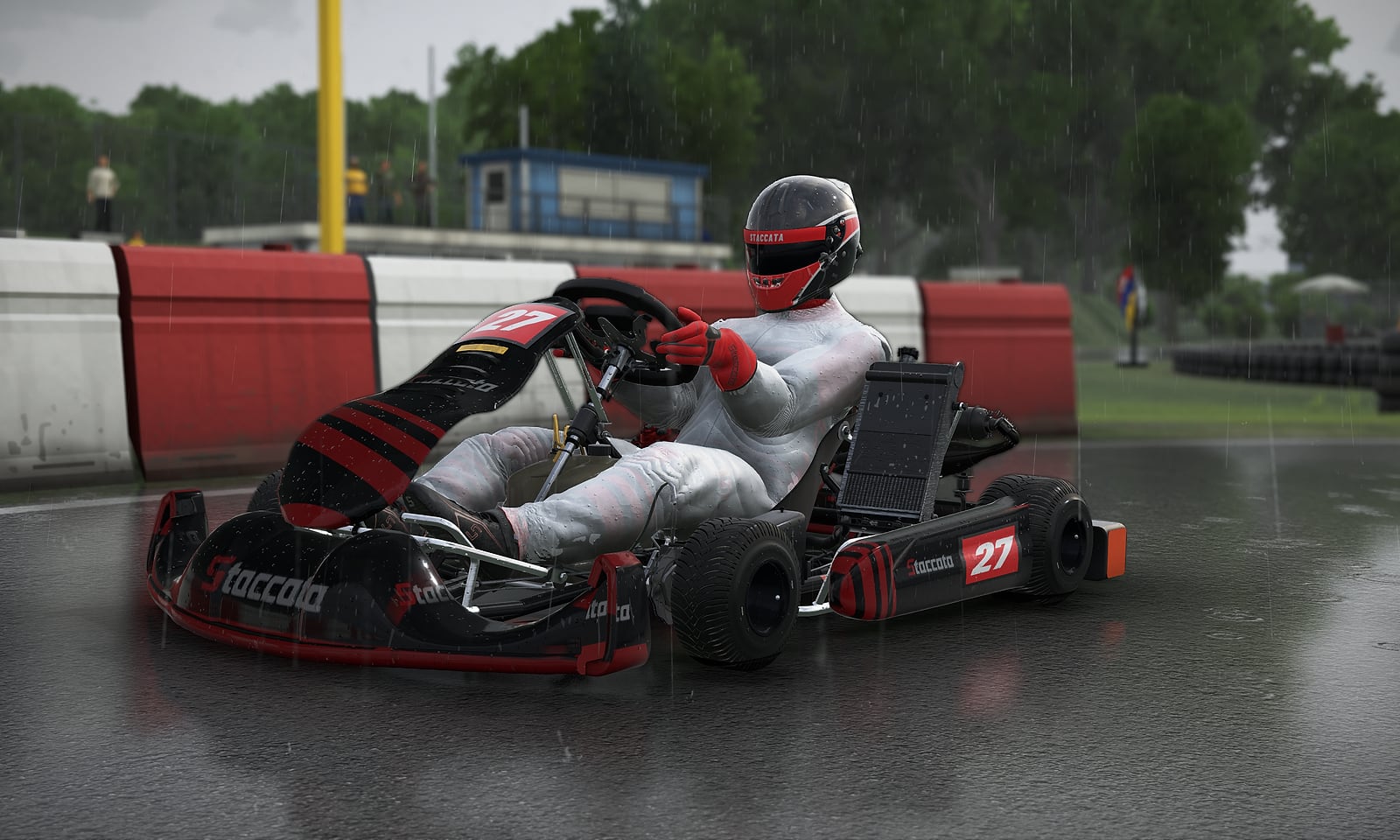
A wet setup is not a slightly adjusted dry setup. It is a deliberately extreme configuration built around one idea: even with almost no grip, the kart has to rotate. A stiffer rear frees the inside rear sooner, and more caster and a wider front jack the kart harder. Every change below serves that goal.
Drill
Low-grip setup
Goal: 2 valid laps each with A and B, then compare
| Item | Wet direction |
|---|---|
| Rear track width | Narrower: Sodikart gives 1370–1380 mm overall for the wet (1400 mm in the dry), and other chassis often go narrower still. This is the biggest and most important change; the same wet sheet also calls for a stiffer rear axle (a TH20 instead of the dry TM20 on the KZ). Both stiffen the rear: the inside rear goes light sooner and the kart rotates even on wet asphalt. |
| Front track width | Wider, often to the maximum the chassis allows. With front brakes (KZ2, DD2) Sodikart caps it at 20 mm of spacers per side. More front grip, more jacking, sharper turn-in. |
| Caster | More. It forces the jacking and the load transfer you need. |
| Toe | More toe-out, for quicker response when the front is reluctant (Sodikart: 2 mm dry, 7 mm wet). |
| Seat / ride height | Leave the seat and the rear ride height low. A higher centre of gravity does transfer more load, but in the game it costs time in the wet too (some manuals recommend it for the wet). Raising the front only adds a little caster. |
| Tyre pressures | Clearly higher than in the dry: wets run about 1.0 bar cold and 1.0–1.2 bar hot. They need heat and a rounded profile to cut through the water. |
| Gearing | Longer: take teeth off the rear to soften the power delivery and reduce wheelspin. |
| Front bar | Stiffer, for more front bite: the Sodikart KZ/DD2 wet sheet fits the stiffest, vertical blade (the RS uses a flat blade). Chassis differ, so check your manual. |
| Bodywork | Make sure the rain kit is fitted correctly and nothing can fill with water or come loose. |